His continental childhood in Germany and his studies in Copenhagen may have contributed to Lennart Rodhe’s difficulties in adjusting to the Academy in Stockholm. He did not start painting at the Academy until his final years, when Sven X-et Erixson was his professor. An arrangement with an old woman as a model captured his interest in 1944, giving rise to a long series of studies and variations on the theme. Several of these studies (Study for Actress), (Study for Actress), (Study for Actree,) all made in 1944, are in the Foundation’s collection, along with Untitled, Study for Actress from 1944. These paintings show influences both from cubism and from the colours and wild brushwork of Matisse. Rodhe has not endeavoured to create harmony in his studies; instead, these images are characterised by strong, unsettling contrasts between light and darkness. Despite the involuntary isolation, the young artists were not unaware of developments in a war-torn Europe, and these existential and dark traits began to appear in Rodhe’s post-war works.
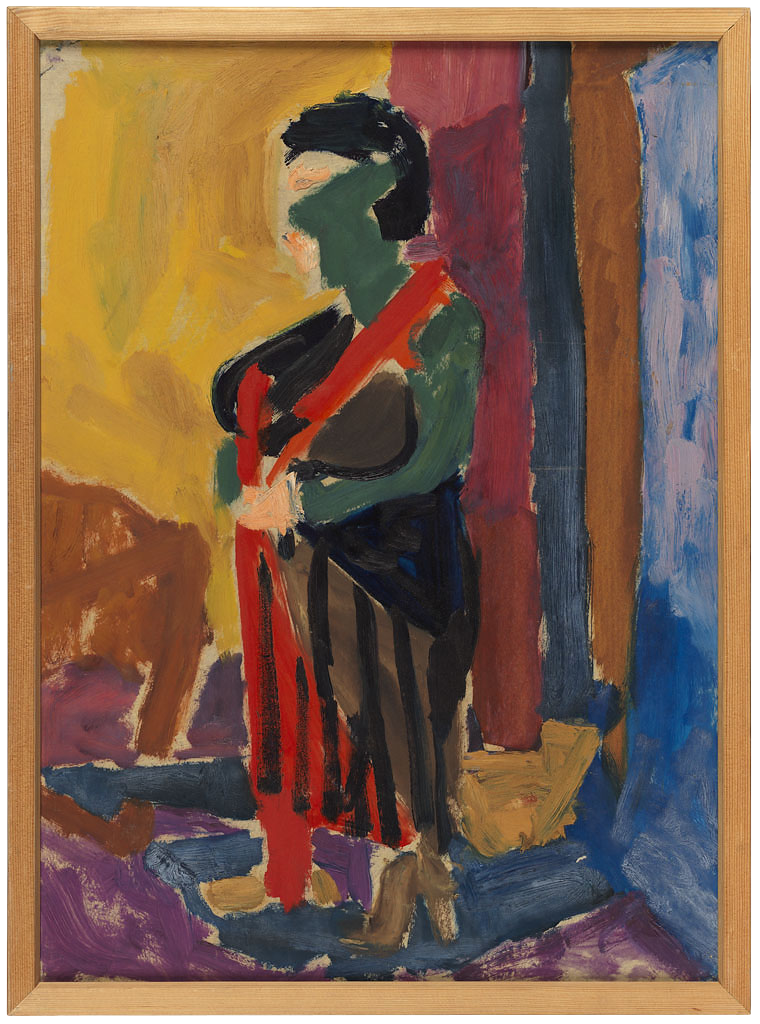
Studie Skådespelerskan, 1944 ca
Further reading
Thomas Millroth, Lennart Rodhe, Sveriges Allmänna Konstförening, Uddevalla 1989
Börje Magnusson och Thomas Millroth, Rodhe som grafiker, Atlantis, Värnamo 1993
Per Bjurström, Bagateller, Carlssons bokförlag, Malmö 1995
Per Bjurström, Blockteckningar och reseskisser, Carlssons bokförlag, Malmö 1995
Mailis Stensman, Rodhe som textilare, Norstedts förlag, Värnamo 1995
The book Rodhe som grafiker (Rodhe as a Graphic Artist) includes a comprehensive biography and bibliography, along with an index stating where his prints have been exhibited.